Nature Journals
Montana Sky
There’s nothing quite like being surrounded by mountains on all sides. No matter where you look, all you see are large, beautiful projections shooting out from the earth. At times, it feels isolating. However, it can also feel comforting, almost like you’re enveloped by a big blanket. My family’s house sits up on a hill with excellent views from every angle of their wrap-around porch. Every morning during my visit in Bozeman, MT, I would sit on the porch and and soak up the beauty of the surroundings. I would wait and watch the whole world wake up, all while just drinking my coffee. The warm pink and orange sun peaked over the mountains as if saying “good morning” to everyone who saw it. The soft morning light highlighted every edge and curve. As the warm hues faded, the blue sky slowly opened up to a beautiful summer day. The morning came and went, and the harsher afternoon light came down, slightly blurring the details that were once present just a few hours prior. It’s amazing how different something can look depending on the time of day. The field that lay in front of the house was home to a number of animals, also waking up to the rising sun. The creeks rushed through the field and although you couldn’t see them through the thick grass, you could hear the water moving gently. I usually don’t consider myself as a morning person, but these mornings in Montana were so beautiful, that I might change my mind.
A Run on the Trinity
I didn’t discover all the Trinity River had to offer Fort Worth until this past year. Now, every chance I get, I make use of Trinity Trails. One of my favorite things to do is drive to the Woodshed trailhead and run up the river to Clearfork and back. The river may not seem like much, it’s dark, murky, and winding. But upon closer inspection, there is so much more to it that you might miss the first time around. Down on the banks, a silent crane is standing watch, just waiting for its chance to catch a fish. In the water, a fish jumps on the surface, disrupting the once still and calm water. Turtles sun bath on the banks, attempting to keep themselves warm. You have to look quick to see them because the second you run by, they slide off the rock and into the water. Running allows me to lose myself in my thoughts and observe my surroundings without judgment. I love to run without headphones because it forces me to be conscious in what I’m doing, rather than zoning out and “just getting it over with”. I have turned to running outside as a way to really soak in nature, with the added benefit of exercise, rather than purely doing it for the latter. Once I reach my destination of Clearfork, I turn around and head back the way I came. Even though I just ran these exact steps in reverse, everything looks completely different. The crane is now on the opposite side of the bank. The fish are jumping in new areas. I notice trees that I didn’t the first time and the path itself almost seems different. Careful observation of my surroundings has made me truly learn to love running outside and I have the Trinity river to thank for that.
My Walk to Campus
Last year, I lived off campus for the first time. I lived in a house that was only two streets away from campus and I could see the TCU-bricked buildings if I stepped out into my street. I lived so close that it seemed like a shame to not walk to class every single day. This year however, I moved to a house that is about a mile from campus. No longer can I see the TCU buildings. No longer do I get to walk through the beautiful campus to go to class. Now, I drive myself to class and park in a lot right next to my building. I walk straight in to my class and then I drive home. Over the last month, I discovered how much I missed my daily walk on campus. So, I decided that I would walk to campus more often, especially now that the weather is slightly cooler. I began my walk down the street and I instantly noticed more than I ever have while driving. There are no sidewalks on this portion of the street, so I was forced to walk right next to the curb. My neighbor’s dog began barking, and before this, I didn’t even realize they had a dog. Pecan trees line the streets and provide a comforting shade on either side. Fallen pecans lie half opened in the grass, possibly explored by a hungry squirrel or varmint. I noticed how desperately the streets need to be repaved. They are uneven and have quite a few potholes. When driving, I subconsciously navigate them to find the smoothest part of the road. Walking allowed me to see the severity. Cars drive past, slowing down as they pass me. The hustle and bustle of Berry street is much more prominent while walking. You can actually hear the cars and the people, rather than just drowning out the noise. It’s amazing how much more you can observe when you take a second to slow down and just look around. Although my walk to campus wasn’t the same as it used to be, I still enjoyed it. Instead of seeing large oak trees, campus buildings, and other walking students, I was now walking past large pecan trees, old homes, and driving cars.Taking the Dogs for a Walk
While in Bozeman, MT, I found myself in awe of the beauty of the surroundings. I’m not sure if it was because nature in Texas is vastly different than in Montana or if it were some other reason. One day during my visit, I went outside with the dogs to take them for a walk through the big pasture. Two horses, five dogs, and one cat all live on the property and they, just like me, love going outside and exploring the surroundings. I walked across the gravel road and immediately crossed a creek. Even though it was right by the road, I hadn't noticed the creek prior to this because it was hidden by trees. The water softly ran under the handmade bridge. We made our way through the tall grass, stopping every once in a while, to throw a stick for the dogs to chase. The house looked so small up on the hill from out in the pasture. There is a second creek on the other side of the pasture. When we arrived at this creek I sat on a rock and relaxed while the dogs played in the water. The water was absolutely freezing, but the dogs didn't seem to mind. I was told that there were trout in this stream and I although I looked for them, I didn’t see any. I’m sure they were right in front of my eyes but were camouflaged too well for me to even notice them. The horses heard us walk up and meandered over to the stream to grab a drink of water. My cousins had dammed the creek to make a swimming hole. This stream provides water for the animals, is a home to the fish, and a great swimming spot for the dogs. It provided sustenance, a habitat, and entertainment for all those that used it. I noticed just how versatile nature is and it made me question whether we really have the right to “use” nature. A similar question was posed in class: do we have the right to dominate nature? I’m not sure I have an answer to that. However, I think we absolutely have the right to enjoy nature, as long as we appreciate it.
The Golf Course
Last weekend, I decided to go home for a few days. I live in Lakeway, TX, which is just west of Austin and located right on Lake Travis. My neighborhood is pretty big and developed, but there is a large golf course right in the middle of it. I drive past this golf course every single day and I even worked there last summer. Despite seeing it every day, it never really dawned on me that this was a big nature-filled area in the middle of a large, developed area. Besides playing golf, people also often walk their dogs, go for walks, and go for runs on this golf course. It truly is beautiful, with creeks and waterfalls running all throughout the course. The trees are so large that you can hardly see the surrounding houses and streets. My parents walk the course with my dog every single day, they love it! I think that people are drawn to areas like this because people are drawn to beauty. Edward Abbey refers to nature and wilderness as a “necessity of the human spirit” and I definitely agree. I wonder about people’s definitions of beauty in nature and if that affects their everyday choices. Personally, I love lots of greenery and bodies of water. But I know other people, like Edward Abbey, find desolation and dessert areas beautiful. Some enjoy mountains while other enjoy beaches. My parents chose to live in this house because they loved the area and they loved the neighborhood. I had to wonder however, if the golf course wouldn’t have been there, would they still have been drawn to this house? Besides the obvious amenity of getting to spend time outside while golfing, I think that this little slice of nature is what really draws people to neighborhoods like mine.

Arches and Abbey
Last class, we read and discussed some pieces written by Edward Abbey. I loved his humor and how he described the beauty of Arches National Park. While reading, I was instantly taken back to my trip to Arches about 10 years ago. At the time, I was only 11, so I didn’t have a huge appreciation for National Parks and how amazing Arches actually is. My parents wanted to go mountain biking and hiking through the whole park in the dead of summer, but my brother and I were not having it. We would’ve much rather stayed in town and gone to the shops or do an activity that involved being inside in the AC. Looking back on it now, I can’t imagine ever not wanting to go explore the beauty of Arches National Park. I would love to go back now. Deserts are usually described as desolate and flat. There’s not much greenery and life, yet Arches is so striking. I think it’s important to have perspective when you’re observing nature. If there are any preconceived thoughts in your head, it ruins the experience of being in nature and appreciating it for what it is. I think there’s beauty in the differences and imperfections of nature. Abbey definitely did a great job for appreciating nature in its natural state, rather than encouraging nature that is modified it to be more appealing to humans. National Parks do a great job of making sure that the areas stay as close to natural as possible, which I think is awesome! Abbey wouldn’t be too happy about all the tourism and parking lots, roads, etc. that go into making these areas accessible, but I do think that he would be happy that people are getting out and at least experiencing it. Especially the arches of Arches National Park, they are such a feat of nature!
Exploring the Redwoods
The first thing that comes to mind about the Redwood Forrest
is WOW! My family and I are staying in Sonoma, CA for the weekend and today we
went and explored the Armstrong Redwood Forrest, which is a small pocket of the
much larger (and further) Redwoods. The trees of this forest are up to 2000
years old and their size truly shows their age. The park service did a great
job of marking some of the oldest trees and explaining their age and size. I
felt so small standing in this forest full of giants. I stood at the base of
one the giants and looked straight up but couldn’t even see the top. It was
over 300 feet tall! There was so much history that can be seen just by looking
at a cross section of one of the trees. You can tell if it was a wet year or a
dry year. The rings even tell you how much growth occurred, and which years
fires have occurred. It’s amazing how much nature can tell you just by examining
it closely. It really brought me perspective on the sheer magnitude of the age
and size of this forest. These trees were here before the US was even a country
and before CA was even a state. They were here before humans had discovered
them, and they will continue to be here thousands of years into the future. This
idea can be applied to all nature, and not only just this forest. Nature has
always been here and will continue to be here long after humans are gone. I
think it’s vital to step back and see the big picture every once in a while.
Today, the giants of the Redwood Forest helped me do just that.

Wine Country
Before my trip to
Sonoma, California, I would not consider wine country to be “real nature”.
However, I was definitely mistaken. The vineyards in this area consist of hundreds,
some even thousands of acres of beautiful grapevines. The amazing part about
visiting in the fall is that all of the leaves on the vines also change color along with the trees. Kunde Family Winery was my favorite winery that we went to and had by far the prettiest estate vineyard. As we walked through the rows of vines, I was stunned at how many
different colors there were. Vibrant orange, red, and yellow interlaced with
dark maroon made for the most picturesque landscape. Each vineyard we went to
consisted of about a 45-minute drive up a small two-lane road. Normally when someone
else is driving, I typically look at my phone or talk with the other people in
the car with me. But this time, none of us were talking, we were all looking
out the window at the infinite rows of vines. We pulled the car over and hopped
out on the side of the road to take pictures at every chance we got. The vines
go right up to road, so we found ourselves wandering four, five, maybe six rows
back. The grapes were much tinier and darker than I expected. Definitely
different from the grapes you see in the grocery store. Some of these
grapevines were hundreds of years old and had base vines that looked large like a
tree trunk.

Canoeing on the Trinity
I honestly did
not know what to expect when I drove out to the Nature Center for our canoeing adventure
on that chilly Wednesday afternoon. I have kayaked and canoed a few times and
have definitely enjoyed myself, so I was looking forward to the venture.
However, I am not a huge fan of the cold weather, so I was not sure I’d enjoy
the experience this time around. We got in the canoes and began rowing down the river in
the direction of the area we placed the erosion mats. We had walked the banks
of this part of the river 5 or 6 times at this point, so it all looked familiar
but also different due to thew new perspective. The water was fairly calm despite the cool
wind that came down across the water. Once we passed the area of the erosion
mats, the mouth of the river narrowed and began to wind. The trees covered us like
a tunnel as we navigated our way through fallen tree trunks, rocks, and debris.
The dense forest softened the wind and the water was so calm, it had a glassy
appearance. It became more and more beautiful the further back we canoed. Every
once in a while, a fish would jump out of the water. Birds were flying overhead
making loud, siren-like calls. I looked down and noticed an oily substance in
the water but wasn’t quite sure what it was. Although it looked interesting when the sun hit the substance and created a rainbow, it definitely
was unnatural and didn’t belong in the water. The most amazing part of this canoeing
adventure was feeling like I was in another world. I’m not sure if it was the
weather, the scenery, or something different, but It didn’t feel like I was in
Fort Worth, TX. This just goes to show how amazing the scenery in nature can be
in all places. You just have to go out and put in the effort to find it.

Amon G. Carter Museum
Fort Worth has a
number of museums packed with art and history. I always see the signs that
encourage visitors to attend the Amon G. Carter, Kimbell, or Modern Art Museums
of Fort Worth. I don’t consider myself someone who knows a lot about art. I
typically enjoy art that is “pretty”, however I don't have much of an eye for
technique. I was pleasantly surprised about how much I enjoyed the Amon G.
Carter Museum of American Art. I loved the landscape paintings the portrayed “ideal”
versions of landscapes inspired by real places. I really enjoyed the soft, blended
colors in the sky and the major attention to detail that most of the paintings
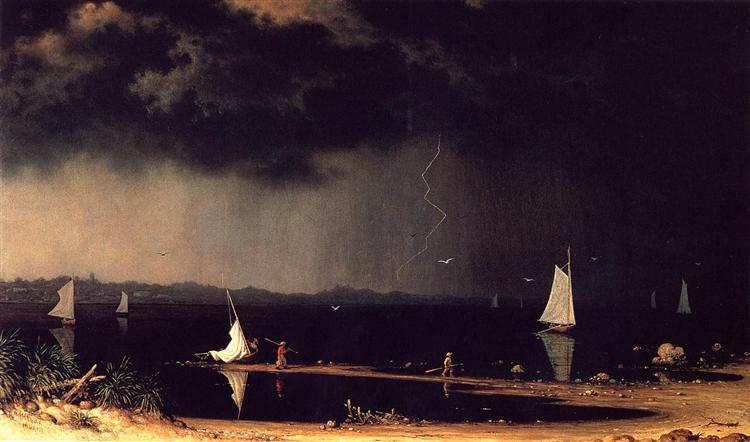
showed in the foreground. The most striking painting to me was titled “Thunderstorm on
Narrangansett Bay” and was painted by Martin Johnson Heade. It depicted a dark black and grey sky with rain coming down and lighting striking the water. Sailboats were
rushing into shore in attempt to escape the rain. This shows that while nature
can be beautiful, it can also be quite harsh. I feel as if this painting really
told a story by just capturing one image, which I think is amazing.
Changing Leaves
My family moved from
Fort Collins, CO to Austin, TX my freshman year of college. I loved Colorado
and really enjoyed growing up there but was excited to hear that my parents
were moving to the place they have always wanted to live. Throughout the last few months of Texas fall, I
realized just how much I missed experiencing fall in Colorado. Colorado is
known for its beautiful, although short, autumnal seasons. The aspen trees
change slowly, and then all at once, starting out green and transitioning to a
bright yellow color. If you’re lucky and time it just right, you can see the aspens
flash bright red up in the mountains. Last class, we discussed Ackerman’s piece
about the leaves changing color on trees. I have seen leaves change color every
single year but didn’t ever question it, I just accepted it as the way things
happened. Reading into detail about the science behind it made the biology
major inside me jump for joy! I never realized that the colors were actually
there all along and that the beautiful green color of the trees masks up the
reds, oranges, and yellows that the colder weather brings out. To the trees,
this is merely a survival mechanism. However, to us the observer, it is
perceived as beauty. I think there is something to be said about how death, the
tree and leaves in this example, brings beauty and new life, the beautiful
colored leaves.
Trinity in the Fall
While filming for
the final video project, I took a few minutes to soak in the Trinity River once
again. My earlier observations were in September, when the weather was warm,
and the trees were all green. Today, the weather was quite chilly- in the low
40s. It was finally starting to feel like fall in Fort Worth. Trinity Trails
were absolutely empty, which is quite different to what it normally is when the
weather is nice out. I sat on a large stone that acted as a bench and looked
out across the water. It wasn’t obvious which direction the current was moving due
to the strong breeze blowing across the water. The birds were flying overhead
and chirping out a loud, happy tune. Rather than the sound of the hustle and
bustle of people on the trails, the majority of sound came from the nearby
bridge. Besides the bird calls, all I could hear was the zoom of cars across
Rogers Ave. and University Ave. The trees were barren and almost looked dead. To
me, the river looked much prettier in the summer than in the winter. The winter
version of the Trinity was desolate. Although the surface looked barren, I was definitely aware of the bounty of life living beneath the
surface, just waiting for the warmer weather to come before they make themselves appear once again.

Under the Snow
I really enjoyed
reading the excerpt from John McAphee’s Under
the Snow. His unique style of creative nonfiction drew me in to the story he
was telling despite it not being a work of complete fiction. Typically, I am not
a fan of reading nonfiction, however when told in story form, nonfiction becomes
more interesting. He explains that mother bears often run away and leave their cubs
in the den when humans get too close. I have always pictured mother bears as
ferocious and willing to stop at nothing in defense of her cubs. This could be
attributed to the stories you often hear of bear attacks, which often occur
when the person stumbles upon bear cubs and/or the den. I didn’t realize that
mother bears can get scared too, and their most feasible option at the time is
to run off. I think that this shows just how misunderstood nature can be. Wild
animals in particular are often depicted in movies, media, etc. as different
from how they actually act in nature. This gives the general audience a false
sense of wildlife which, in my opinion, is detrimental. I hear so many stories
about people who find bear cubs, or baby buffalo, or a baby dear and take them
into their cars because they were “cold” or “lonely”. To most people, this is an
obvious incorrect decision; however, some truly believe they are helping the
animals. I think that this goes along with the ignorance that is present in
society towards natural surroundings. Not only does this apply to local and
global geography, but knowledge of local wildlife species as well.
The Land Ethic
I thought that
Aldo Leopold took an interesting stance on land conservation and ethics. He
commented on the fact that humans often take advantage of the land the we live
and use but don’t realize it. He focuses a lot of his writing on land ethics, which
is somewhat of a strange concept to me. It makes sense to have ethics in a
decision-making or business setting, but to apply ethics to the land? That
seems a bit more complicated. In typical ethical dilemmas, one party has to decide
whether or not something is morally right/wrong un regards to an action that may or may not harm a second party. In this situation, we as humans are the party making the
decision and the second party is the environment, which really has no say in
how we treat it. We as humans are making use of what the environment is
providing for us, but edge dangerously close to taking advantage of it. Leopold
argues that we are definitely taking advantage of the earth and the environment.
By utilizing earth’s resources, we are bettering our own environment- but at
what cost? Leopold encourages his reader to “think like a mountain”. I think
what he means in this scenario is to look at the bigger picture. Short term from
a view through a magnifying glass, we are helping ourselves with no immediate
consequences and no ethical decisions are involved. However, when thinking like
a mountain, we can step back and look at the environment and all that it can provide
for years and years to come. Then the true harm and consequences come into
light. This shows us how important it is to make ethical decision now so that we don’t face further consequences
down the line.


Comments
Post a Comment